Showing posts with label Japan. Show all posts

Japan: Shrines & Temples

Tuesday

The Shrines and Temples of  Japan are revered and well preserved. Kyoto (about 2.5 hrs away from Tokyo by train) is the shrine and temple mecca of Japan as unfortunately World War II bombing destroyed much of Tokyo's architecture and art. So if you're in Japan, try to make it to Kyoto.

One question we did have was.... What's up with this?

We saw what we knew as the offensive Nazi Swastika included in various works of art and outside many religious buildings. Knowing that the symbol had to have pre-dated Nazi Germany, I left it to my 'go-to-guy', "Mr. Something". It just so happens that the symbol meant Life and Good Luck for 3000 years before the Third Reich adopted it as their brand.

Back to Kyoto... The autumn leaves were at the height of their color change and we were happy to be in the middle of it all. Most of Kyoto's Temples and Shrines are located along Tetsugaku-No-Michi aka "The Path of Philosphy" the walk is about 2 miles. At first, I was intent on remembering the names of all the beautiful places we visited but then it wasn't long before I canned that idea and decided just to enjoy them. Very Zen.

These are just a taste of the places we visited...
Rokuon-ji Temple/The Golden Pavilion
The Ginka-Ju Temple/Silver Pavilion

Nanzen-ji (I think)
Chion-In Shrine
 
Higashimayu? No idea.
No clue
I know it's Shinto
Tokyo
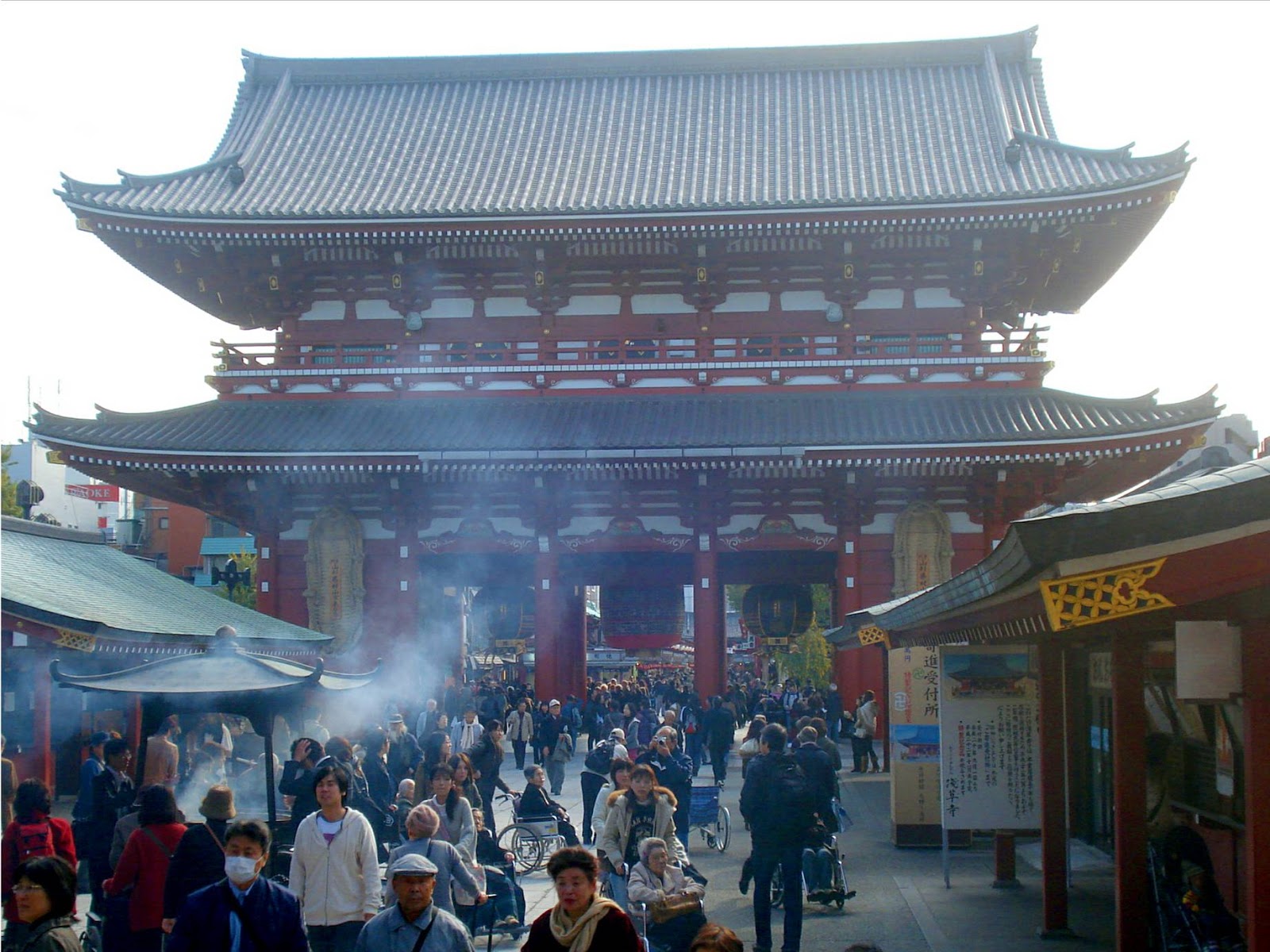
Senso-Ji
The smoke is incense used prior to entering the temple for cleansing mind and spirit
Marketplace at the entrance to Senso-Ji

Japan: The Food

Sunday

Restaurant-Hunting in Tokyo
 We found a quote in one of our travel books... "The Japanese eat with their eyes, not with their stomachs" - or something like that. In Japan it's all about food presentation.
The windows of many Japanese restaurants are filled with their menu items displayed in plastic. I had heard that creating fake food is quite an art-form in Japan and that the top plastic food artists are sought after.

In the mood for fish? Checking out the plastic food display is one option. We had no idea if what we had decided on was beef, chicken, pork, duck, seal, octopus or eel,  but if it looked good, we were sold.

Other restaurants presented menus with color photos.
And then there were the vending machines...
Restaurant vending machines are all the rage in Japan. First, select your menu item from the vending machine. Then, put your yen in the machine and out pops a ticket. Take a seat in the restaurant and give your ticket to the server who passes your ticket to the cooks. Before you know it, your hot food is in front of you, you eat and you're out of there. Lingering during a meal is just not the Japanese way.

The vending machine market is huge in Tokyo. Not only can you get your basic drinks and snacks but you can also find everyday household items such as vacuum cleaner bags, batteries, subway passes and greeting cards in the plethora of vending machines located around Tokyo.
Typo?   

Sushi bars were popular but many were 'stand-up' sushi bars. By the time it came to eat, this 'lingerer' needed to sit. We eventually did find a 'sit-down' sushi restaurant and although my Texan husband was averse to the thought of eating "raw fish"... I loved it.

Early on in our Japan trip we became keenly aware that as 'Westerners', we stood out like sore thumbs and were watched closely by the servers and cooks in restaurants. I'm thinking they were checking out our facial expressions as we were served the food they had prepared.

This particular dish required a 'poker face'.
...and he will not eat Sushi

Japan: Mass Transit

Wednesday

As far as we know, there are three separate underground train systems in Tokyo (there could be more). The Metro line, The Toei line and The JR line.
We got lost. A lot.

Fortunately the train line signs were color-coded, numbered and most were in both Japanese and English.

A word of caution from one traveler to another... if you ever find yourself in Tokyo and having to navigate the subway system, you can choose the 'hard way' (the trial and error method) or take the 'easy way'. Choosing your station 'number' and not trying to remember its name is 'easy'. Remembering the number of where you exited the station is another key point consideration in taking the 'easy way'.

The difference between exiting the Asakusa Station ( G19) vs. Akasaka Station (C06) and leaving the station at exit A5 vs. exit B4 could make a serious impact on marital harmony.

We learned the hard way.

I doubt seriously there was ever an argument against mass transit in Japan. The population of Japan is 127.5 million people and it is approximately the size of California. Now, imagine squeezing in 1/2 of the entire population of the USA into California. I don't think they'd fit, especially if they insisted on bringing their SUV's and/or Ford F150  pick-up trucks along.

The Japanese train system is incredibly precise, efficient and civilized.

Once you get to the train platform, everyone stands in line on areas that are clearly defined on the floor that tell you where the doors of the train will open. Sure enough, that's exactly where the train doors open! Then as passengers get out of the train, all embarking passengers stand aside. Nice.

A few of my own personal observation while riding the trains...
  • Cellphones were used to read books or newspapers while commuting. Very little texting going on and I only saw one guy actually talking on his cell phone. There are frequent announcements asking that cell phones are silenced while on the train.
  • Generally, Japanese women and men dress very well. The current trends for young women are false eyelashes, short-shorts or mini-skirts with boots. Most men are in fashionable dark suits and ties with  hip hairstyles. 

  • The trains and stations are very clean and well-lit.
  • Soothing music is played as the subway doors open and close. 
  • We didn't see any hired "pushers".In fact, there didn't seem to be a need for them.
There is something intrinsically wrong with this picture.

    Japan: In Search of "The White-Faced Geisha"

    Monday

    "Maiko" Apprentice Geisha
    I understand that Bird-watchers are known to ...
    1. Position themselves in the target's familiar habitat
    2. Choose the appropriate time of day for spotting.
    3. Familiarize themselves with the target's plumage.
    While visiting Japan, my personal mission was to spot a real, live Geisha and this was to be accomplished by...
    1. Positioning ourselves in the Gion district of Kyoto.
    2. Lurking the streets of Gion at dusk (best time of day for Geisha-spotting). Camera at the ready.
    3. Being on the lookout for a Japanese woman with a startling white face, wearing a brilliant Kimono..
    Gion District at dusk. No evidence of a Geisha yet.
    Doug didn't get it. "What's the big deal about seeing one in white face?" he asked, after taking pictures of women in traditional Japanese dress.
    I just couldn't let him think all Japanese women in kimono were Geisha. Whether or not he cared, my husband's education into all things Geisha began as we strolled the streets of Gion.

    I started by telling him about my immersion into the story of a beautiful, young girl beginning her apprenticeship as a Geisha in Gion and subsequently following her throughout life in the fictional "Memoirs of a Geisha" by Arthur Golden. The book depicted relentless dedication and commitment in becoming a Geisha. Although not all those in Geisha 'circles' feel it is an accurate portrayal of their lives, it opened my eyes and sparked my interest in these mysterious women.

    Trying not to come off all smug, I recited a litany of things I just knew were signs of a real Geisha...
    • Geisha make-up is white, opaque and flawlessly applied with skin exposed at the nape of the neck.
    • Geisha do not carry handbags or shopping bags...they have 'people' to do that sort of thing for them.
    • Geisha hair is black and with every last hair in place. It is not cut short or styled in a messy updo.
    • "Geisha" means "person of art" in Japanese. They are formally trained in dance and music.
    • Geisha posture is perfect.
    • Apprentice Geisha are called "Maiko".
    • Geisha are cultured and skilled party hostesses - not prostitutes. 
    • The current rate to hire a Geisha for a party is $200-$300 per guest for two hours of her time.
    • The Geisha kimono reflects the Geisha's status. 
    • There are less than 1,000 practicing Geisha today.
    He still didn't get it. So I calmly explained...."I just want to see one OK?" Enough said.

    The white-faced Geisha hunt continued ...and then...

    She was across the street from us, being followed by photographers and on the arm of a distinguished looking gentleman.
    Can you see her?
    OK, not the best shot.And then she was gone as quickly as she had appeared.

    About an hour had passed without a Geisha sighting. I slacked off. My level of alertness had declined when . Doug says with urgency,  "Joanie, get your camera! Get your camera!". Sure enough, running with little baby steps directly towards us in her beautiful kimono and wooden flip-flops with white socks was a real-live white-faced Geisha! She disappeared into the darkness before I could get a shot of her.

    It was then that I realized just how fast those Geisha can move. I remained hopeful. I had to be on my toes if I were to get a picture of a Geisha.

    We were attending a light show that night at Chion-in Temple, and it just happened to be located very closely to Gion, maybe... just maybe... we would get another chance..


    And then, in the distance, coming down a massive flight of stairs, a white-faced Geisha!
    Despite accusations of stalking, I followed her around in the dark with my cell phone cam...
    You've got to be pretty quick to catch a shot of a Geisha
    No, she was not running away from me. I think she was just leaving.

    Japan: Dear Japan

    Currently, my body thinks it's 6 pm in Tokyo. My mind tells me that it's 3 am in Dallas. So it seems to me that this is a good time as ever to start documenting our trip to Japan. .
    _________________________________________________________________________

    Marketplace at the entrance to The Senjo-ji Temple in Tokyo

    Dear Japan,

    In planning our first trip to Japan, we expected there to be a few 'snags' along the way , what with the language barrier, difference in culture, currency and customs. Preparing ourselves for potential problems is an expectation of international travel and we were OK with that. So, we took it upon ourselves to learn a few polite Japanese phrases, read a book on "Japanese Culture" and carry a copy of The Lonely Planet's "Japan"  before traveling 13.5 hours to get to you.

    First of all, if I knew how to speak Japanese, I would have told you personally just how much I appreciated your hospitality and patience with us during our week in Tokyo and Kyoto. "Arigato gonzaimas" (Thank you very much) just doesn't seem to express our sincere thanks.

    I have never been treated so kindly and so respectfully in any other foreign country. Despite the fact that many of the people that we were exposed to were in the service industry, it appeared that the desire to please and provide guidance was their sole motivation.We are still at a loss to explain the high  level of customer service that we recieved considering that tipping is not common or expected.

    On our first night in Japan, we decided to find our hotel by using the train and subway system. The map that I picked up was in Japanese. If you look closely, you can see why this was a problem.

    Thanks to the  Japan Rail-Man at Ochanomizu Station, we were given a smile, a nod, an English map and a directional point followed by "one-two-three" (we assumed these were the number of blocks to our hotel)

    By the grace of God we made it.  It was late. It was pouring rain, We were soaking wet and exhausted. But, it was our 13th wedding anniversary. So, we sucked it up and went out to dinner. Not far from our hotel, we  found a noodle-bowl diner with pictures of food that you could choose from. It was the best bowl of noodles with an unknown meat source that we have ever had! Throughout our meal it was evident that the waiter and the cooks were watching us for our reaction to the food. Afterwards, we were presented with a complimentary plate of "Goyuza". Just because.

    "Goyuza" Japanese Potstickers filled with vegetables
    Then there were the silent majority of Japanese on subways and streets. Not once did I feel crowded, pushed or nudged. Personal space is remarkably respected given the population of Tokyo (12,800,000 ) That being said, I recall seeing "Pink" subway cars designated for women only. These "Pink" cars were implemented as a result of groping complaints experienced during rush hour. How thoughtful  Also, we did not expect quiet deference while visiting the Tsukiji Fish Market. You made it clear through your guidebooks that it is a working fish market and not supposed to be a tourist attraction but we chose to take our lives into our own hands while dodging one-man fish trucks speeding around market corners like bats out of hell. I guess they have a job to do and we respect that..
    Staying out of the way at the Tsukiji Fish Market


    Thank you for your degree of hygiene. Japan has got to be the cleanest country I have ever visited.

    I'll begin with the traditional Japanese toilet. I guess I didn't get to that part in my "Japan" book because when I first walked into a Japanese ladies restroom, I was surprised by what I found...
    Japanese Toilet - Flush with your foot

    Instructions are always a good thing.
    Odd. But most definitely sanitary'

    Secondly, thank you for including instructions on proper handwashing techniques. Well done Japanese Department of Health and/or Infection Control.

    The use of surgical face-masks run rampant in Japan. I suspect that you wear them to protect yourselves from germs as well as to prevent passing on germs to others but I am not certain as to when or why this practice started. Anybody out there know? It certainly makes a lot of sense and shows a high regard for social responsibility.

    My book on Japanese Culture said that "Blowing one's nose in public is considered to be disgusting by the Japanese people" (as well it should be). I did not see any nose-blowing in Japan. For that, I am grateful.


    Thank you Japan for a great trip.